Innovation Atlas
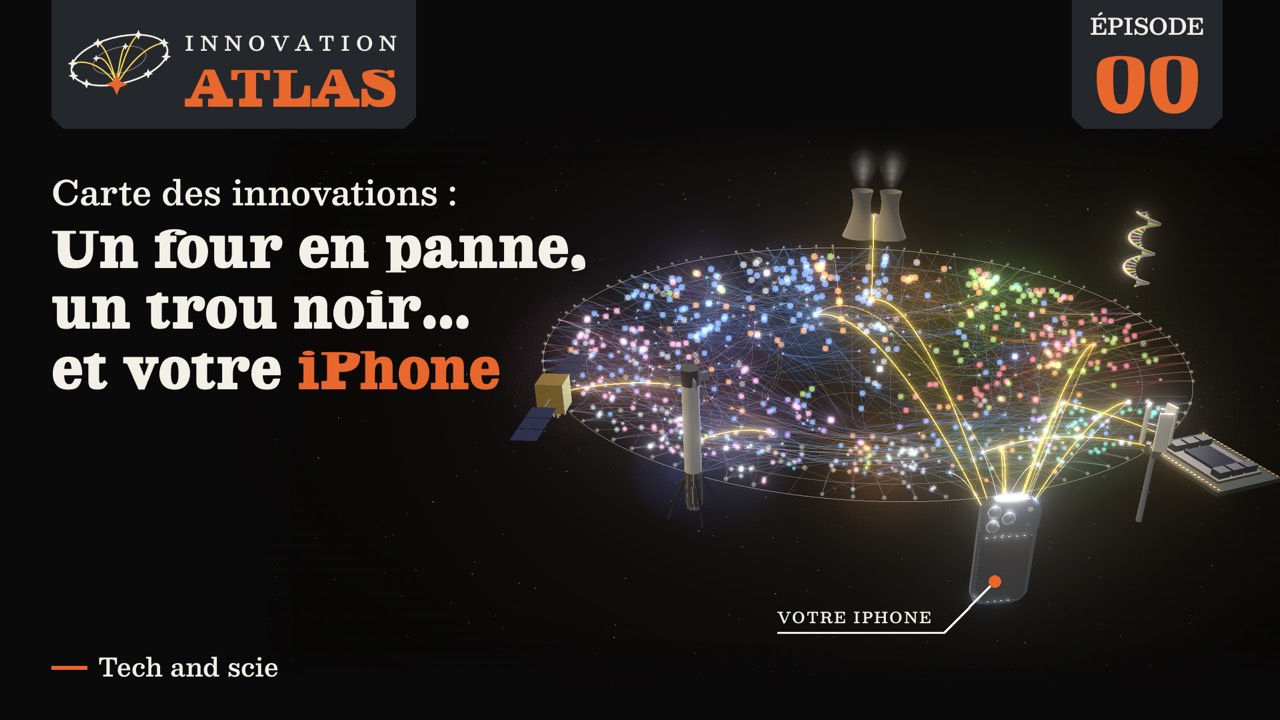
The map of innovations: take an object apart, follow the beams from its parts and travel, star by star, back through the true stories that made it possible.
Watch the video · A broken furnace, a black hole… and your iPhoneVariables
- Guided journey: pick an episode, from E00 to E03; play, pause, step timeline, link to a moment and subtitles in French or English.
- Views: Atlas, the 3D map; Object; Plan, with published dimensions; Timeline, the stars in order of time; List.
- 3D object: iPhone 18 Pro, Voyager probe, EUV lithography machine or Falcon 9 rocket. Assemble it, explode it, isolate a part.
- Beams: switch them on to link a part to the stars it descends from, then fly to one of them.
- Filters: kinds of star (people, discoveries, innovations, places, objects), constellations, episodes and years, from 1666 to 2026.
- Search: find a star by name. Its card gives our summary, the bridges told, the Wikipedia excerpt, the Commons image and, for a released episode, the moment the video tells it.
Key figures
- 142
- stars: 44 people, 46 discoveries, 24 innovations, 13 places and 15 objects
- 9
- constellations, across the site’s four fields
- 144
- links told: 29 bridges, 54 lineages and 61 actor links
- 4
- episodes, each with its 3D object and guided journey
- 1666–2026
- from Newton splitting light to Voyager 1’s light-day
What happens, step by step.
- 01
A map where time radiates
Every point in the atlas is a star: a person, a discovery, an innovation, a place or an object. Distance from the centre follows time: at the heart, the origins, with Newton splitting light in 1666; on the outer ring, today, up to the light-day Voyager 1 reached on 18 November 2026. Recent centuries get more room than older ones, and the disc sinks towards the oldest discoveries.
- 02
Nine constellations, four fields
Each sector is a constellation: space exploration; the infinitely large; the infinitely small; great machines and matter; energy; reading and writing life; health; information and computing; Earth, seas and sky. The atlas thus spans all four of the site’s fields, from computing to medicine. A single story often leaps from one constellation to another: that is where bridges are born.
- 03
Four objects to take apart
Each episode starts from an object: the iPhone 18 Pro, the Voyager probe, an EUV lithography machine, the Falcon 9 rocket. Assembled, it looks like a single block; exploded, it shows its parts: the display glass, the plutonium generators, the tin source, the landing legs. The Plan view draws its published dimensions, each with its source.
- 04
Beams to the stars
A highlighted part sends beams towards the stars it descends from. The iPhone’s cameras lead to the sensor conceived in 1993 at NASA’s JPL for space probes; Voyager’s generators lead to a stormy night in 1941, in Berkeley, when plutonium was identified. A beam shows where a part comes from; it does not claim the part would have been impossible without that single discovery.
- 05
Bridges
144 links connect the stars, each one told by an episode. A lineage follows a single line of descent: from the maser to the laser, then to the lasers of Face ID. An actor link connects a person to what they did. A bridge leaps from one field to another: a hunt for mini black holes that found nothing leads to Wi-Fi; the limit of light found by Ernst Abbe in 1873 for microscopes applies to the machines that draw chips.
- 06
One journey per episode
Every Sunday, an episode of the Innovation Atlas series starts from an object and travels back, through true stories, to the discoveries that made it possible. The guided journey revisits its stops. For E00 and E01, each step links to the chapter of the video where it is told. The journeys for E02, on 6 December 2026, and E03, on 13 December, stop before the end of the episode: the ending is yours to discover.
- 07
How we check
Every fact comes from its episode’s verification file: primary sources where they exist (papers, the Nobel Foundation, NASA, press releases), otherwise several reliable sources. Any error found is corrected in the data before it enters the atlas. A figure given by a company or the press is attributed to it, and an uncertain fact is removed rather than rounded off.
- 08
Wikipedia, Commons and our texts
Star summaries, bridges and journeys are written by Tech & Scie. Each card adds the lead of the matching Wikipedia article, under the CC BY-SA 4.0 licence, with a link to the article, and, when one exists, a free image from Wikimedia Commons with its author and licence. The episodes’ sources are listed below.
What the scene simplifies
- Symbolic positions: distance from the centre follows the year, on a scale that gives recent centuries more room. Within its sector, a star has a stable but arbitrary place: two neighbouring stars are not necessarily linked.
- A place, or an innovation spanning decades, has no single date: its position on the map is a landmark, not a birth date.
- Timing: a guided journey lasts four to five minutes. It revisits some of the episode’s stops, not its pace, and does not replace the video.
- Objects simplified inside: the exterior and the main parts follow published dimensions; cables, electronic components and internal details are grouped or left out.
- Dimensions: the Plan view only draws published dimensions, with their source. Other proportions are estimated from photographs and carry no dimension line.
- Exploded view: the spacing between parts is chosen for legibility; it shows neither the assembly order nor the exact position of fasteners.
- Beams and bridges: a part descends from a great many discoveries; the atlas only shows those the series tells. It grows every Sunday and does not claim to be a complete tree of science.
- Wikipedia excerpts and Commons images are frozen on the date they were retrieved; the online article may have changed since.
Further reading
- G. H. Beall (2016) — Dr. S. Donald Stookey (1915–2014)
E00 · the first glass-ceramic.
- Corning — History of strengthened glass
E00 · from 1960s strengthened glass to the first iPhone.
- Newton Project — I. Newton, letter to J. Locke (1691)
E00 · Newton’s experiments on himself.
- NASA — Webb’s mirrors
E00 · the Webb telescope’s mirror.
- San José State University — Einstein (1917), stimulated emission
E00 · stimulated emission.
- National Academy of Sciences — C. H. Townes, biographical memoir
E00 · the 1951 park bench and the maser.
- HRL Laboratories — The first laser
E00 · Maiman’s ruby laser, 16 May 1960.
- Apple Newsroom (2017) — iPhone X and Face ID
E00 · more than 30,000 projected dots.
- American Chemical Society — Discovery and development of penicillin
E00 · Fleming, then the Oxford team.
- American Physical Society — December 1938: Discovery of nuclear fission
E00 · Meitner, Frisch, Hahn and Strassmann.
- Nobel Prize — Nomination archive, Lise Meitner
E00 · 49 Nobel nominations.
- IEEE Milestone — First semiconductor integrated circuit (1958)
E00 · Kilby’s circuit.
- Krizhevsky, Sutskever, Hinton — NIPS 2012
E00 · AlexNet.
- Prime Minister’s Prizes for Science (2009) — J. O’Sullivan
E00 · from black holes to Wi-Fi.
- NASA JPL — The NASA imager dentists use daily
E00 · Eric Fossum’s CMOS sensor.
- NASA — Voyager blog
E01 · the light-day and the empty signal of November 2026.
- NASA — Voyager mission fact sheet
E01 · the probe and its dates.
- A. J. Butrica — Voyager: The Grand Tour of Big Science, NASA SP-4219 (1998)
E01 · the cancelled grand tour and the “less grandiose” probes.
- Lawrence Berkeley National Laboratory — Gilman Hall
E01 · the night of plutonium, February 1941.
- Idaho National Laboratory — Atomic Power in Space II
E01 · plutonium-238 and the generators.
- NASA — Basics of Space Flight, chapter 4
E01 · gravity assist.
- L. A. Morabito — arXiv:1211.2554 (2012)
E01 · Io’s volcano, 9 March 1979.
- Ludwig & Taylor — Voyager Telecommunications, DESCANSO, JPL (2002)
E01 · Voyager’s voice and the Reed–Solomon code.
- NASA — Voyager blog (15 March 2024)
E01 · the 2024 repair.
- Denso Wave — QR code error correction
E01 · the QR code, a code from the same family.
- H. Kinoshita — J. Vac. Sci. Technol. B 23, 2584 (2005)
E02 · the first extreme-ultraviolet images.
- ZEISS — Technological milestones in microscopy
E02 · Carl Zeiss and Ernst Abbe.
- CSET (2022) — Tracing the Emergence of Extreme Ultraviolet Lithography
E02 · thirty years of EUV lithography.
- ASML — Light and lasers
E02 · the tin droplet struck twice.
- IEEE EDS Newsletter (2021) — A. Yen, a personal journey
E02 · 90 watts, October 2014.
- CNBC (14 Oct. 2026) — ASML third-quarter results
E02 · machines that will not be enough.
- The Planetary Society (21 Dec. 2015)
E03 · the first stage to land upright.
- Smithsonian — Wonder Weapons and Slave Labor
E03 · the V-2.
- L. Blackmore (2016) — Autonomous Precision Landing of Space Rockets
E03 · a calculation made for Mars.
- Columbia Accident Investigation Board — Volume 1, chapter 1
E03 · the space shuttle between flights.
- collectSPACE (30 March 2017) — SES-10
E03 · the first stage to fly again.
- NOIRLab / IAU — Starlink trails (ann19035a)
E03 · Starlink trails at Lowell Observatory.
- NASA — Crew-2 mission overview
E03 · the Endeavour capsule flies again.
- Aerospace America — First Starship tower catch
E03 · the tower catches Super Heavy.
- AIAA (25 Aug. 2026) — Falcon 9 booster’s 37th flight
E03 · thirty-seven flights for one stage.
- Creative Commons — CC BY-SA 4.0
Licence of the Wikipedia excerpts shown on the cards.
Eight paths to innovation, and the map that connects them.