Inside a quantum computer
From cryostat to junction, open the machine, follow a signal and discover what every part does.
Watch the video · Majorana 1Variables
- Twelve-step story, play, pause, speed and links to specific moments
- Eight scales, from metres to nanometres; free or guided camera
- Parts: hide, isolate and understand their purpose
- Exploded view, rotatable section and temperatures
- Control, flux, readout, pump and helium signals
- Surface code: distances 3, 5 and 7
Key figures
- 105
- Physical qubits on Willow
- 10 mK
- Reference temperature in the scene
- 60 dB
- Krinner chain attenuation
- 68 µs
- Mean Willow T₁, QEC chip
- 2.14
- Error suppression factor Λ
- 0.143%
- Logical error per cycle, d = 7
What happens, step by step.
- 01
A centimetre-sized chip needs a whole room
The chip carries qubits; racks generate pulses and process responses. A cryostat, compressors and gas-handling system maintain the cold. This scene combines Willow performance, documented Sycamore details and a Bluefors XLD: it is not a replica of Google’s machine.
- 02
Why cool to 10 mK?
At 5 GHz, h·f/kᵦ is about 240 mK. Mean thermal occupation falls from about 1,250 photons per mode at 300 K to 4 × 10⁻¹¹ at 10 mK. Pulse tubes precool; helium-3 entering the dilute phase from the concentrated phase then absorbs heat. A qubit’s effective temperature may remain higher.
- 03
Control without room-temperature noise
In Krinner’s reference 6 GHz chain, three 20 dB attenuators each replace 99% of incoming noise with their own stage noise. Noise falls to about 0.0023 photons per mode. Shields, filters and packaging each protect against a different disturbance.
- 04
The junction makes the circuit a qubit
The cross capacitor stores charge. The Josephson junction provides the nonlinearity that distinguishes the 0 → 1 and 1 → 2 transitions. A 25 ns XY pulse performs rotations; a tunable coupler enables a 42 ns CZ gate. Bloch spheres describe mathematical states.
- 05
Listen before coherence is lost
The qubit shifts a resonator response. Isolators and amplifiers let its phase be read without sending all amplifier noise back down. Willow readout error is 0.77%. The error-correction chip has T₁ = 68 ± 13 µs: relaxation returns the state towards |0⟩, while dephasing erases coherence.
- 06
Distributed logical information
The d = 7 patch uses 49 data qubits and 48 measurement qubits, with 4 leakage-removal and 4 unused qubits among the 105. Parity checks do not directly read logical information. A classical decoder tracks corrections. Logical error reaches 0.143% per cycle; enlarging the code reduces it by Λ = 2.14 ± 0.02.
- 07
Majorana: the goal versus the evidence
The Majorana branch keeps cryogenics but uses InAs–Al devices, gates and an in-plane magnetic field. The 2025 Nature paper demonstrates parity readout, not the presence of Majorana modes. The July 2025 tetron remains a preprint, with very different Z and X lifetimes. Halos are hypothetical; these results do not establish a complete topological qubit.
What the scene simplifies
- Composite machine. The chip and performance figures are Google Willow’s; geometry, materials, packaging and electronics follow its predecessor Sycamore because Willow’s are not public. The cryostat is a Bluefors XLD wired as at ETH Zurich (Krinner 2019), not Google’s cryostat.
- Xmon-type crosses follow dimensions published in 2013; Willow’s exact qubit shapes are not public. Qubit pitch and chip dimensions are estimates.
- About 450 actual lines are represented by a few dozen representative cables. One control, readout and flux line are followed end to end.
- Diameters of the 50 K, 4 K, still and cold plates and their shields are estimated from photographs (±10%); only the 500 mm mixing-chamber plate diameter is published.
- Timing is educational: cooling takes roughly a day, a drive pulse 25 ns and a correction cycle 1.1 µs; each is shown over seconds. Microwave signals are invisible, represented here by light packets.
- Aluminium films (about 100 nm), junction oxide (1–2 nm) and Majorana heterostructure layers (nm) have exaggerated thickness, with the factor displayed.
- Bloch spheres, energy levels and IQ clouds are mathematical representations, not physical objects.
- The order of the four CZ layers follows a standard convention (Tomita and Svore); Google’s exact order is given only in a figure. Willow uses the ZXXZ variant, shown here as the familiar X/Z surface code.
- Correction is represented as decoder inference; in practice it is often tracked in software, without a corrective pulse.
- Colours for signals, states and qubit roles are visual conventions. Materials retain their physical colours: gold-plated copper, stainless steel, aluminium and silicon.
- The Majorana tetron follows the July 2025 preprint (InAs–Al Majorana 1 platform). Halos lie inside the wire ends; Majorana modes have not been demonstrated. The carrier board is simplified and has no logo.
- No Google, IBM, Bluefors or Microsoft logos appear on the models.
Further reading
- Koch et al. · 2007
[1] Transmon theory.
- Krantz et al. · 2019
[2] Circuits, gates, readout and decoherence.
- Krinner et al. · 2019
[3] Reference cryogenic setup, thermalization and readout chain.
- Arute et al. · 2019
[4] Sycamore architecture and technical supplement.
- Google Quantum AI · Nature 2025
[5] Below-threshold surface-code error correction on Willow.
- Google Quantum AI · Willow spec sheet
[6] 105 qubits, coherence, gate and readout errors.
- Barends et al. · 2013
[8] Xmon geometry and properties.
- Bluefors · XLD manual
[14] Dilution refrigerator operation.
- Bluefors · XLD
[15] Dimensions and cooling capacities.
- Aghaee et al. · Nature 2025
[25] InAs–Al interferometric parity readout; does not demonstrate Majorana modes.
- Microsoft Quantum · 2025
[27] Tetron and X/Z lifetimes; non-peer-reviewed preprint.
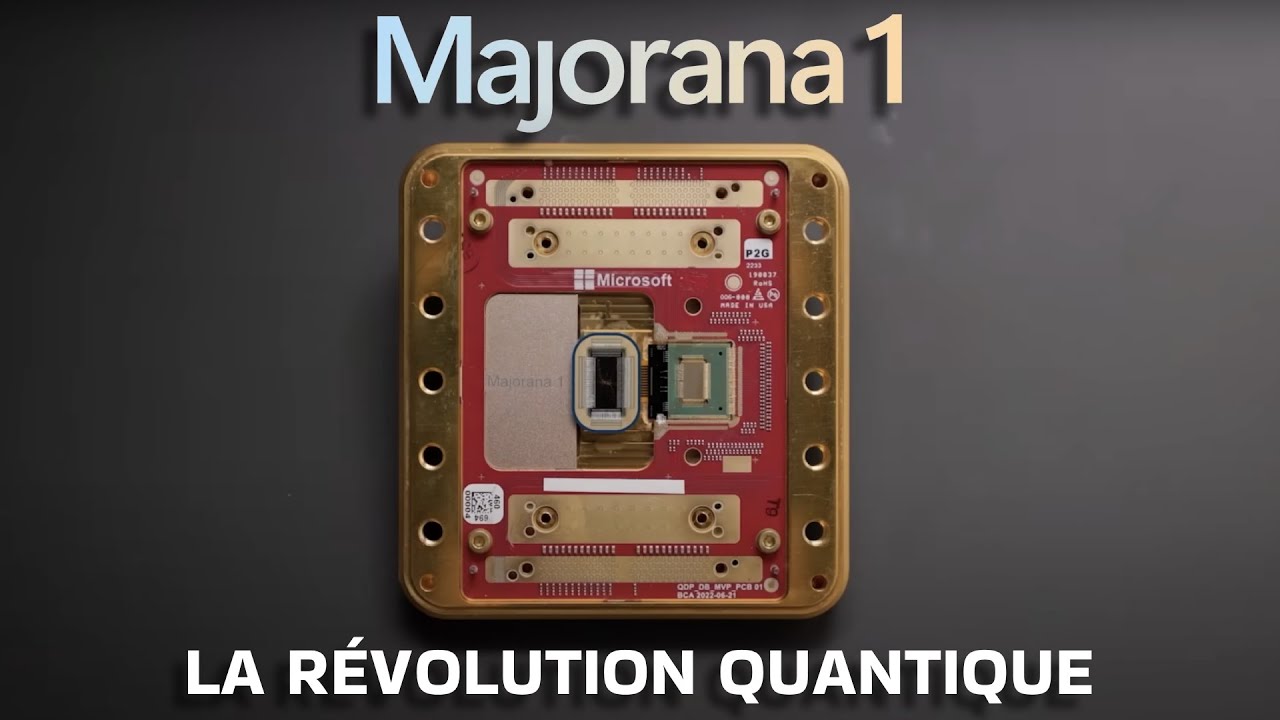
Microsoft’s topological bet for the quantum computer.